Author: Marketing AR

04 CLIPPATRICI PNEUMATICHE PER PRODUZIONE DEI DIVANI .

The advantages of pneumatic clinch tools in sofa production

What are pneumatic clinch tools and how do they work?

Clinch tools are tools that, using clips, make it possible to fasten two or more materials together through mechanical force. Clinching happens in a fast, safeway, used above all to tie cables and wires together.

Using it is very simple: being a pneumatic tool, it needs compressed air which, passing through the machine, compresses the clip, deforming it so as to close it fast, safe.

Clips are made to have a very strong hold and are often used in producing sofas and on mattress springs.
AR Assemblaggio enters the world of clinch tools by offering Hartco tools which, after careful market study, prove to be among the best available on the market for a wide range of advantages.

The main use of this valuable tool is in the world of sofas and textiles, a choice dictated precisely by the long series of advantages it brings.

Metal clips are an excellent method of clinching the webbing in sofas that forms the base for comfort, making it incredibly solid, without giving up the right softness that means rest and relaxation.

The clinch tool is often recommended to ease fastening operations, as it gives the worker a great ally that helps with the job.

This tool greatly simplifies the work and lets fastening operations be finished in the shortest possible time, unlike other types of fastening with manual tools.

The adjectives used to describe clinch tools are certainly: fast, reliable, safe and versatile. Their pneumatic operation makes them easy to use, since you just press a button to make a clip fastening in an instant, thus considerably speeding up the work and clearly saving effort.

Workers will love it and companies will notice the time saved and the incredible increase in productivity of the production line.
Sofas and sofa beds will be made safer, more stable and with considerable time savings. Clinch tools can also hold different clip sizes, so as to work on several fronts depending on the need at hand.

What types of clips are available on the market?

The choice of usable clips is manifold; each is more recommended than others depending on the work you want to do, so in this section we’ll clarify what is best to choose based on the job.

AR Assemblaggio is a specialist retailer of clips and can offer a wide choice of them, both in terms of material type and size.

To be long-lasting and durable, AR Assemblaggio offers a range of iron clips with different amounts of galvanising – from 25 to 250 grams – which provides greater protection to the iron base.

Galvanising is applied to an iron base mainly for two factors:
– The first is to prevent corrosion, which, if the iron were exposed to air, would in certain conditions be easier and faster.
– Its durability, estimated to last from 41 to 121 years. This range matters in order to account for any external factors that may speed up deterioration.

It also offers aluminium clips, a material highly recommended in industry as it has excellent mechanical characteristics at a low cost.
Clips in stainless steel are suggested where a very strong fastening and zero oxidation are needed.
AR Assemblaggio on request, it can make clips in materials other than those listed above, giving the customer the chance to choose, according to their needs, the best option for the best result.

The clinch tool also avoids damaging the two materials to be fastened, making the application of clips a completely safeoperation.

Another important parameter to consider is the size in which clips are made, which, depending on their size, withstand more or less particular stresses.

The width ranges from 11 to 22 millimetres and the internal dimension can reach a diameter of about 10 millimetres.

These sizes naturally cover a large number of feasible jobs, also allowing bundles of several cables to be closed together.

Another parameter to bear in mind is the quality of a fastening made with a clinch tool, which turns out elegantly done, without burrs , since a cold mechanical modification takes place in the clip.

What other applications can the clinch tool perform?

Fastening several materials, besides sofas and cables, is much in demand in industry, enabling other types of work too.

Building structures or cages is greatly simplified by using a pneumatic clinch tool, and its speed makes construction very easy and every joint very strong .

03 I chiodi per fissaggio industriale

Nails for industrial fastening: different types for different applications

How to choose the right ones?

The nailneeds no introduction – everyone knows it and how it works; whether wide-headed, fine-headed, long, short or made of any material, it remains the undisputed king of fastening.

Their function always remains indisputably necessary, but the various types available on the market make them more or less suited to their apparently simple task.
In this article we’ll clear up any doubts by showing the strengths and weaknesses of each type of nail and which jobs they are more or less suited to.

Coil nails:
These nails are bound together by electro-welding, which keeps them joined, and are usually ordered for large-scale jobs.

The types that can be used in this kind of collation are manifold ; here are some examples:

  • Tapered smooth nails: these are the classic smooth nails, excellent for woodwork; depending on their length they work deep, increasing the hold
  • Tapered ringed
  • Tapered screw (helical)
  • Screw

The choice of nail must always be weighed according to the job, so as to balance cost with the quality of the work. Good hold can certainly be achieved, for example, with screw (helical) nails, but for simple jobs cheaper and equally effective is the smooth nail.
Stick nails:
In industry, this type of nail collation is used for its lightness. Its low weight in fact allows a more manageable use of the nailer, which is easier to handle even over long working periods.
Usually the types available in this format remain the classic smooth and screw (helical) ones.

T-Nails:
This particular type of nail is T-shaped and finds its main use in finishing work in construction and carpentry.
These nails are found mainly in steel and allow a strong hold. The two broad categories they fall into are divided by the material the nails are applied to, namely: steel and concrete, or wood.
So this type of nail becomes necessary for a wide range of applications.

Screw nails:
Sometimes, in certain types of work, the situation calls for timings that must be strictly met, making it necessary to use specific equipment.

Classic nails, such as smooth ones, are sometimes difficult to remove, requiring levers to pull them out which, in most cases, ruin the material they are fixed to.
Quite a nuisance, isn’t it? Yet there is a solution simple and effective one: the screw nail.

Screw nails are nails that have a thread along their length and a cross slot on the head, just like a screw. The advantage of this particular type of nail is that they are designed to be driven in just like a nail, with tools such as the nailer.
It’s easy to see, then, that it can be quickly driven in and easily extracted like a true screw.

To give an idea of the time saved, just think of using a screwdriver, which takes a great deal of time compared to a pneumatic nailer.
A further strength of screw nails is their hold. The thread, besides being a real help in pulling the nail out, creates additional friction for a hold that is far more secure.
Usually screw nails are collated on strips; this way they speed up and simplify the work of workers, avoiding tool jams and saving time, since they come in blocks of 50 pieces.

Pallet nails for pneumatic nailers:
A major need for which nailers are used is making pallets. These platforms are made for transporting goods and serve as a base to keep them off the ground and to allow them to be moved with the appropriate equipment.

In transport companies, then, it’s immediately clear that there are certainly two needs, namely: solidity and safety. Pallet assembly must also be fast, which justifies using a pneumatic nailer, certainly equipped with pallet nails.

This particular type of nail has the peculiarity – besides being available in different sizes and so adapting to making any pallet – of having a slight thread along its length that makes it hard to extract, so the pallet gains high stability and strength.

All these small details will make shipments, whether by air or sea, highly safe. The ease of driving these nails, which can even be large, depends on the power we set the nailer to, which will assemble the platform in very little time.

applicazioni delle anellatrici in ambito industriale

The applications of hog ring tools in industry

What are hog ring tools?

Hog ring tools are fastening devices that, with the help of practical rings, make it possible to create loops able to fasten and join two parts.

The mechanism of hog ring tools is very simple: their shape is similar to pliers, so they have two arms acting as a grip, which provide the leverage to close the ring.

The upper end of these arms is narrower and is the point where the hog ring is turned into a closed ring by the mechanical force applied.

What types of hog rings can I use?

Hog rings that can be applied to hog ring tools take a C shape; you’ll find them arranged in a row and ready to insert inside very easily. For this you simply remove the catch on the back, insert the strip of hog rings and put the catch back on; this way you’ll have the hog ring tool ready to work.

The applicable hog rings are made of various types of material. AR Assemblaggio offers a wide choice of materials that should be chosen wisely based on the application they are intended for.

For example,stainless steel is excellent for closing or joining nets that will be used in water, making it suitable for repairing damaged fishing gear that would otherwise be unusable and costly to replace.

Stainless steel also has excellent mechanical properties that make it strong and durable, as well as avoiding the annoying rust that forms on the surfaces of ferrous materials.

Aluminium is another option; cheaper than steel, it is widely used in industry because it allows a large amount of processing and offers excellent physical qualities that make it resistant to a wide range of mechanical stresses.

Galvanised iron is excellent for repairing nets that may be near corrosive agents. To prevent the corrosion of iron, it is in fact coated with a layer of zinc which, through passivation, protects the iron from corrosive agents and makes it highly durable over time.
Lastly, the zinc-aluminium alloy, which is widely used for work in coastal areas and in high-pH environments, is recognised for its high corrosion resistance.

Hog rings come in many types of material, suited to every need, and this allows them to be used in any situation and on any site. With the right care, you can choose the most suitable one to get great strength and durability.

Another important feature to consider is the thickness of the hog rings, which ranges from 1 to 15 millimetres; here we can really select them based on the force they must bear.

What types of hog ring tools are there?

The types of Hog ring tools available on the market vary by the type of force they use, price and speed of operation.
The three broad categories are:

  • Manual hog ring tool
  • Mechanical hog ring tool
  • Pneumatic hog ring tool

The manual hog ring tool, as its name suggests, makes it possible to create rings without the help of any support device, using only and exclusively the force applied by hand to close the ring.

mechanical hog ring tool is made to simplify the work of the manual one. Its levers are longer and allow rings to be closed by applying considerably less pressure, thus saving time and effort.

And here we come to the real gem among hog ring tools: the pneumatic one. This particular type of hog ring tool is incredibly practical, easy to use and above all fast. With the help of compressed air, generated by a compressor, this hog ring tool compresses the hog rings, creating rings in a very short time with a simple press of a trigger-shaped button.

This type of hog ring tool is in fact recommended for fast jobs that require many fastening points.

What jobs can be done with hog ring tools?

The types of work that can be done with hog ring tools are manifold, especially given the incredible number of functions they can serve.

In making hunting traps or fishing pots and nets, the hog ring tool finds aperfect application. Imagine traps that are made or reinforced with steel or galvanised-iron rings, depending on their final use, or even repaired safely and made incredibly strong.

Fishing pots are always placed on the seabed, where they often face the weather and large fish that can damage or, worse, break them. A hog ring tool can repair them in a lasting way, using stainless-steel rings, resistant to oxidation even underwater.

Industries that produce nets, including those for mattresses, would gain great benefit from being able to apply strong rings between the parts to be joined.

Another use in which hog ring tools are widely used is automotive upholstery , which makes their use indispensable.

01 Come scegliere una chiodatrice industriale

How to choose an industrial nailer

How to choose an industrial nailer

What types exist and how to choose the most suitable one:

In the world of carpentry and structures, nails are a highly recommended tool, firstly for their holding capacity, low cost and incredible versatility of use.
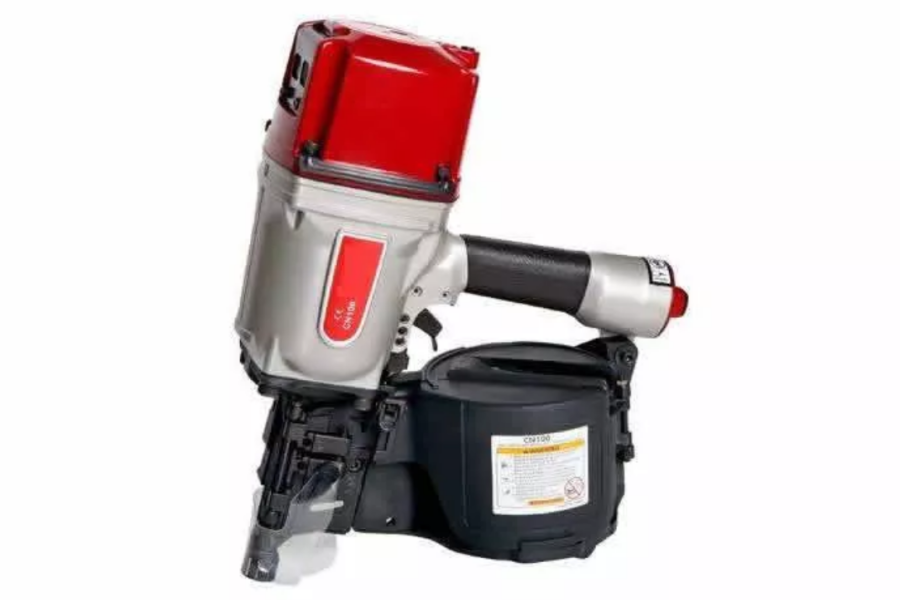
The nailer, or more commonly the “nail gun”, is a tool that lets you drive nails into two or more materials, creating a permanent join in a totally fast and effective way.

But how does the industrial nailer work?

This valuable tool comes in its classic “pistol” shape that allows an easy grip, enabling precise aim at the point where the nail is to be driven. The convenience of the nailer is its ability to hold a large quantity of nails inside, making transport easy and avoiding losing them, as they are kept in a dedicated compartment.

To fire a nail, just rest the nailer with light pressure on the point where you want to create a join, press the trigger button on the grip, and that’s it.

In particular, there are two types of nailer that differ in power source and power.

Electric nailer
The electric nailer is the least powerful, as it uses rechargeable batteries, usually lithium, which must often be replaced since it uses high energy consumption to work. There are also corded ones that partly solve the recharging problem, but not the power one.
They are nonetheless advantageous in small worksites, as they can be carried anywhere in total comfort thanks to the absence of cables.

Pneumatic nailer
The pneumatic nailer works differently; this tool has a higher power than its electric counterpart, thanks to the use of compressed air at high pressure. The pneumatic nail gun has a tank cylindrical, where the compressed air is channelled, generated by a compressor that must always be present on site; pressing the trigger releases the air, pushing the nail out of the nailer’s muzzle.
The convenience of a pneumatic nailer is priceless, since the advantages it offers are truly significant; it lets workers complete fastening operations in very little time, thus minimising intervention times and allowing companies a huge saving.

The alternative to the nailer would be the classic hammer which, however much it is still used in carpentry, is obsolete compared to this tool. Let’s stop and think: how long does it take to drive a nail with a hammer? It might take about ten seconds.
Naturally without considering nails that can bend or get lost. The nailer was created to overcome these drawbacks: a compartment to insert the nails to limit losses and, with power and precision,to drive them into the designated surface in complete safety.

What to consider in an industrial nailer

The choice of an industrial nailer must always be weighed against the jobs you want to carry out, so as to make a purchase perfectly suited to your needs.

The nail gun has a variable weight and this must always be taken into account based on the job to be done; for example, you can’t use models that are too heavy for work on scaffolding or ladders, to avoid losing your balance.

The MCN55 nailer, for example, weighs 2.70 kilos, which makes it perfect for any job, and can hold from 300 to 350 nails, for long, uninterrupted work.

The nail diameter is variable, from 2.1 to 2.3 millimetres, and the length ranges from 25 to 57 millimetres. This way, with the same nailer, you can do jobs with nails of different sizes and carry out a large number of operations.

Another factor to consider is certainly the tool’s noise, which requires dedicated hearing-protection equipment in the case of prolonged use.

Examples of practical applications on site

To sum up, the use of the nailer is placed in working environments that are dynamic and tend to have excellent performance. A classic example of its use is found in transport companies. Companies usually use large quantities of pallets, and assembling them requires a certain amount of timber and, above all, nails.

Using a hammer to make so many pallets would be unthinkable, both for reasons of time and of safe holding of the pallet itself. Using a nailer allows the use of awide variety of nails and considerably speeds up the process of assembling the wooden parts, creating firm, precise joints and consequent transport in safety of the loaded pallets.

A further application of the nailer certainly concerns the partitions of the internal rooms of houses, usually made of plasterboard and wood. A classic method for laying out the rooms of a house with a considerably lower cost and without having to request any change from the local council.

With the nailer, wooden structures will be built with minimal time spent.

Continue reading